- Easy
- 20 min
How to Change Colors in Crochet Without Knots
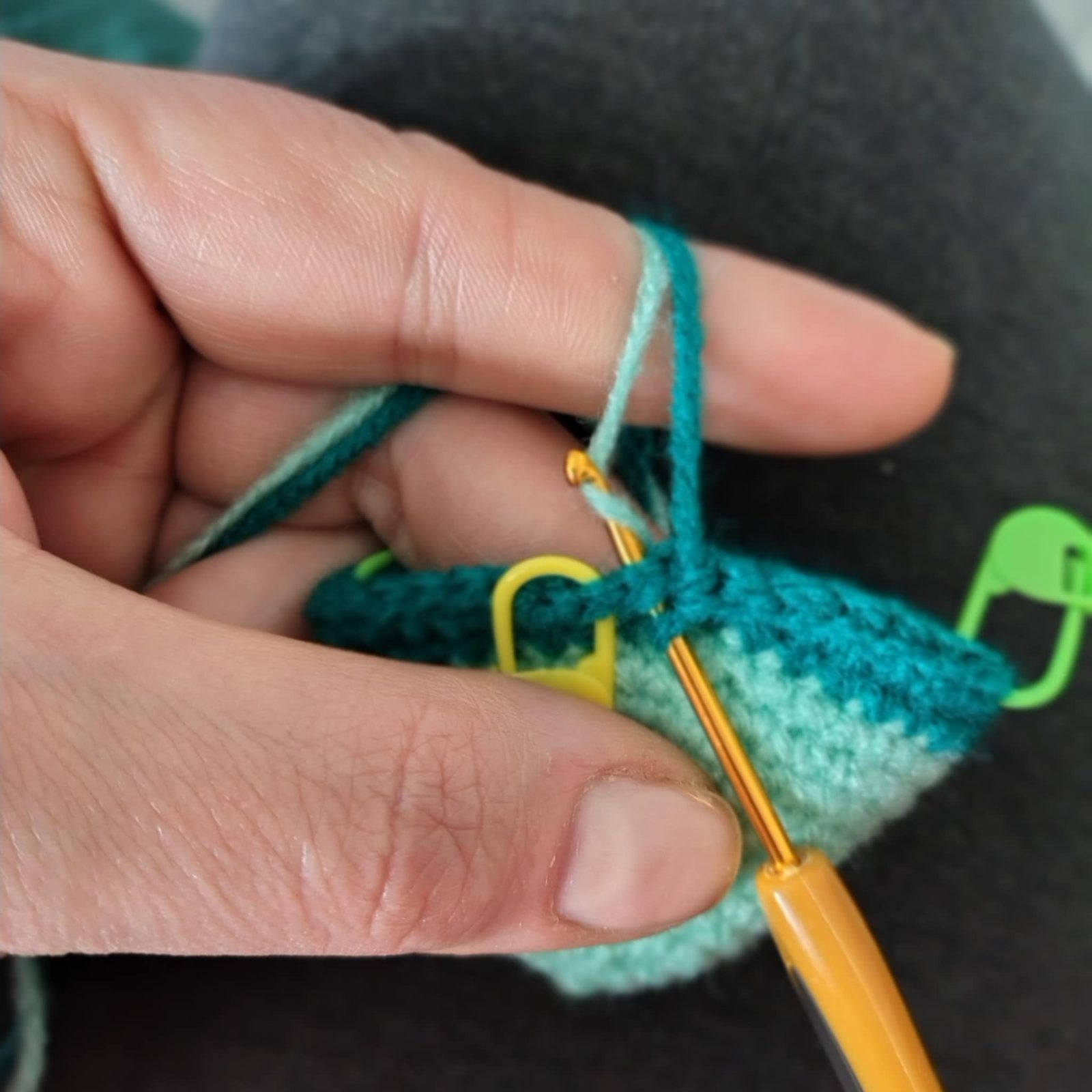

You don’t need a knot to start a new color. The cleanest color change happens one step early: you finish the last stitch of the old color with the new color, so the first full stitch of the new color appears exactly where it should. It’s secure once the tails are woven in, and it doesn’t leave a lump.
US/UK note: This page uses US terms. US single crochet (sc) is UK double crochet (dc); US double crochet (dc) is UK treble (tr).
Why skip the knot?
A knot is tempting because it feels secure, but it has drawbacks: it creates a hard bump, it can work its way to the front, and knots in yarn can slip loose over time. Weaving in the ends is what makes a join secure, not the knot.
Step-by-step: color change in single crochet
- Work the last stitch of the old color until 2 loops remain on the hook. For sc: insert hook, yarn over, pull up a loop. Stop.
- Drop the old color to the back (wrong side) of the work, leaving a tail of about 6 in (15 cm).
- Yarn over with the new color, leaving a 6 in (15 cm) tail of the new color too.
- Pull the new color through both loops. The stitch is complete, and the loop on your hook is now the new color.
- Continue with the new color. Give both tails a gentle tug to snug up the stitches.
- Weave in both tails later, each into its own color section.
Tip: Hold the new color’s tail against the back of the work for the first stitch or two, so it doesn’t pull loose before you secure it.
Color change in double crochet
The rule is the same: change on the final yarn over of the last stitch.
- Yarn over, insert the hook, yarn over and pull up a loop (3 loops on hook).
- Yarn over and pull through 2 loops (2 loops remain).
- Drop the old color. Yarn over with the new color and pull through the last 2 loops.
Changing color at the end of a row
To start a new row in a new color:
- Work the last stitch of the row, changing to the new color on its final yarn over.
- Make the turning chain in the new color.
- Turn and continue.
This keeps the turning chain the correct color, so the edge looks clean.
Changing color in joined rounds
When rounds are joined with a slip stitch, make the color change on the joining slip stitch:
- Finish the last stitch of the round in the old color.
- Insert the hook into the first stitch of the round, drop the old color, and pull the new color through both the stitch and the loop on the hook to make the slip stitch.
- Chain up with the new color and continue.
For granny squares and other motifs where each round begins in a different place, you can also fasten off the old color completely and join the new color with a slip stitch in the corner space where the next round starts. The pattern will tell you where to join.
Color change in a spiral (amigurumi)
In a spiral there’s no end of the round, so changing color creates a small “jog,” a step where the old and new rounds meet. You can make it less noticeable, but not remove it completely while you keep spiraling:
- Change color on the last stitch of the round as usual.
- Work the first stitch after the color change as a slip stitch instead of a sc, then continue in sc. The low slip stitch makes the start of the new color rise more gradually, so the step looks softer.
If you want stripes with no jog at all, work those rounds as joined rounds instead (see above): joining each round is the only way to avoid the jog entirely.
Carrying yarn instead of cutting
For stripes that change every two rows, you don’t have to cut the yarn each time. Leave the unused color hanging at the edge and pick it up when you need it again, bringing it loosely up the side. It saves weaving in, though the carried strand shows at the edge unless you add a border.
Common mistakes
- Changing color on the first stitch instead of the last. The first new-color stitch then has a loop of the old color on top. Change one step early.
- Pulling tails too tight. It distorts the stitches near the join. Snug, not tight.
- Weaving tails into the wrong color. Light tails show through dark sections. Keep each in its own color.
- Short tails. Leave at least 6 in (15 cm) of both colors so you can weave securely.
FAQ
Is changing colors without a knot secure?
Yes, once the tails are woven in properly, in at least two directions. That weaving, not a knot, is what holds the join.
Can I join a new ball of the same color this way?
Yes. Use the same method whenever you run out of yarn. Join it at the edge of a row if possible, where tails are easier to hide.
What is the “magic knot”?
It’s a way to join two yarn ends with two sliding knots so you can keep working without weaving tails. It’s popular but debated: it can work loose in slippery yarn, and the knot can show. The no-knot method on this page is the safer default.
Do I have to cut the yarn every time I change color?
No. For narrow stripes you can carry the unused color up the side of the work. For wider stripes or color blocks, cut it and weave in the tails.
This page uses US crochet terms.