- Beginner
- 10 min
Why Is My Crochet Curling? (Causes and Fixes)
Curling is crochet’s way of telling you that one part of the fabric is shorter or longer than the part next to it. A tight edge pulls inward, a crowded edge pushes outward, and the fabric bends to make up the difference. Figure out which edge is the “wrong length” and the fix is usually simple.
US/UK note: This page uses US terms. US single crochet (sc) is UK double crochet (dc).
Rows that curl at the bottom edge
This is the classic beginner curl: a rectangle whose bottom edge rolls up.
Cause: a tight foundation chain
Most people chain more tightly than they crochet. The chain becomes a short, tight edge, and the stitches above it are wider, so the fabric curves.
Fixes:
- Use a larger hook for the chain only, one or two sizes up, then switch back for Row 1.
- Loosen up deliberately: make each chain the same size as the loop on your hook, and pull the loop up a little taller.
- Use a chainless foundation (foundation single crochet), which makes the chain and first row together and matches their width automatically.
Rows that curl along the whole piece
Cause: tight tension in a dense stitch
Single crochet, especially when worked tightly, makes a firm fabric that can curl slightly. That’s normal to a degree.
Fixes:
- Go up a hook size for a softer fabric, which may curl less.
- Add a border of single crochet around the whole piece, working 3 sc in each corner. A border stabilizes the edges.
- Block it (see below).
Circles that cup or curl up into a bowl
Cause: too few increases
A flat circle needs its outer edge to grow at the right rate. In single crochet, that means 6 increases every round:
| Round | Instruction | Stitch count |
|---|---|---|
| 1 | 6 sc in ring | 6 |
| 2 | inc in each st | 12 |
| 3 | (sc 1, inc) × 6 | 18 |
| 4 | (sc 2, inc) × 6 | 24 |
| 5 | (sc 3, inc) × 6 | 30 |
If you add fewer than 6, or miss an increase or two, the edge is too short and the circle cups.
Fixes: Count every round. If you’re on the right counts and it still cups, your stitches may be short and wide; try a larger hook.
Circles that ripple or wave
Cause: too many increases
Extra increases make the edge longer than it can lie flat, so it ruffles. It also happens if your hook is too large for your tension.
Fixes: Check counts against the table. Rip back to the round where the count went wrong. If counts are right, try a smaller hook.
Cause: stacked increases (hexagon, not curl)
If your circle lies flat but has six corners, the increases are stacked in the same place each round. Shift the increase position on alternate rounds, e.g. (sc 1, inc, sc 1) instead of (sc 2, inc).
Granny squares and motifs that curl or twist
Corners that pop up often mean too many chains at the corners or tight sides. Twisting (the square slowly rotates as you go) is common in joined rounds; many crocheters turn the work after each round to counter it.
How to block crochet flat
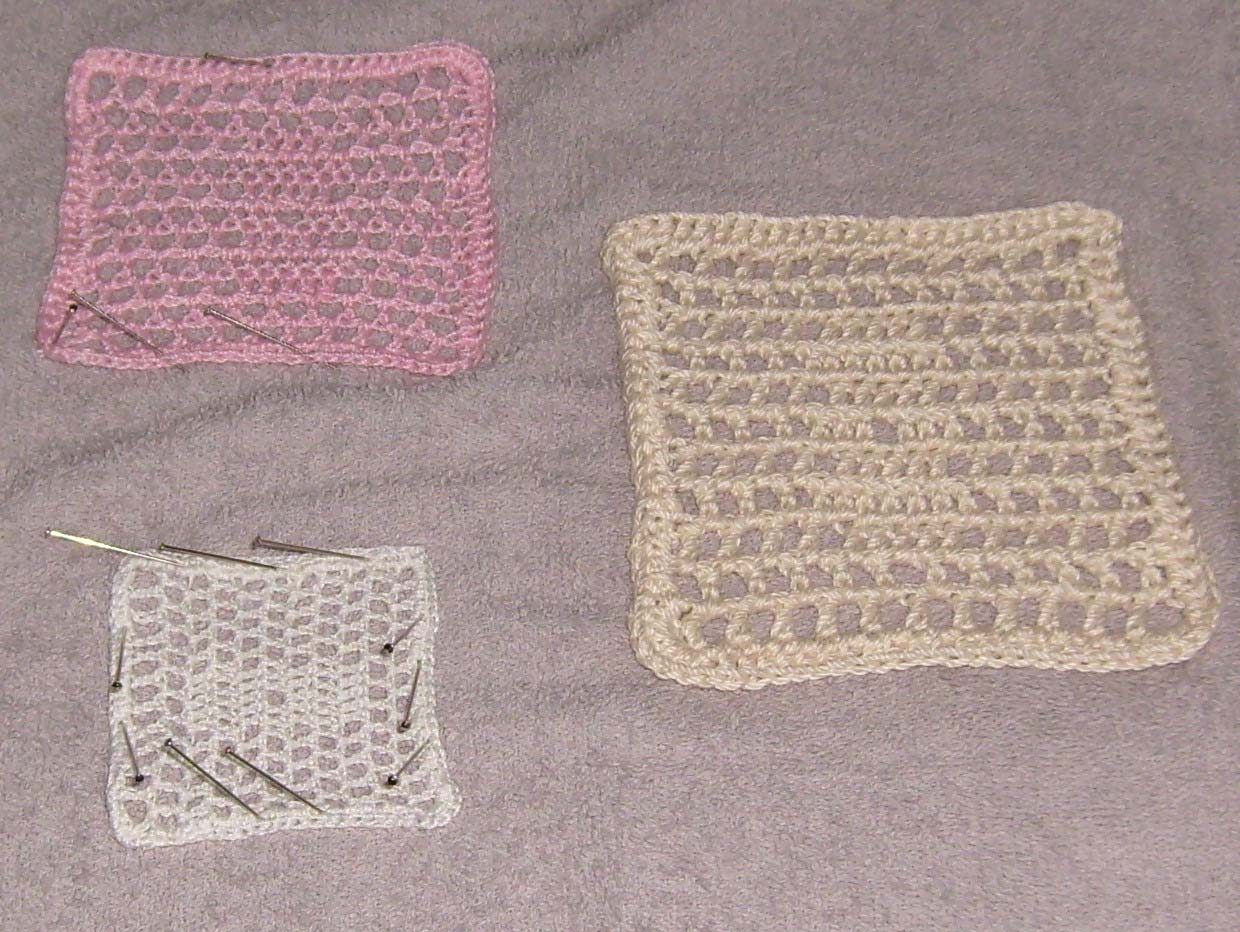
Blocking relaxes the fibers so the fabric holds a new shape. It helps mild curling but won’t fix wrong stitch counts.
- Wet the piece in cool water (or spray it until damp). For acrylic, steam blocking with an iron held above the fabric (never touching) is the usual recommendation.
- Squeeze out excess water gently in a towel. Don’t wring.
- Pin it flat to a foam mat or towel, shaping the edges straight or round.
- Let it dry completely before unpinning.
Tip: Cotton and wool respond well to wet blocking. Acrylic needs heat (steam) to relax; too much heat can flatten it permanently, so test on a swatch first.
Common mistakes
- Expecting blocking to fix stitch-count errors. Blocking smooths; it doesn’t add or remove stitches.
- Pulling the chain tight to “keep it neat.” Neat and tight are not the same. Even, relaxed chains lie flatter.
- Changing hooks mid-project. Different hooks (even the same size from different brands) can change your gauge.
FAQ
Why is my single crochet rectangle curling diagonally?
Rows of single crochet can lean or bias slightly, especially when you always insert the hook at an angle. Work into both loops consistently, and block the finished piece.
Will a border stop my crochet from curling?
Often, yes. A round or two of single crochet around the edge stabilizes it. If the border itself pulls, work it with a larger hook.
Why is my crochet curling in only one direction?
Usually because one edge (often the foundation) is tighter than the rest. Compare the bottom edge to the top: if the bottom is shorter, it’s the chain.
Step photos

This page uses US crochet terms.