- Easy
- 15 min
How to Crochet an Invisible Decrease
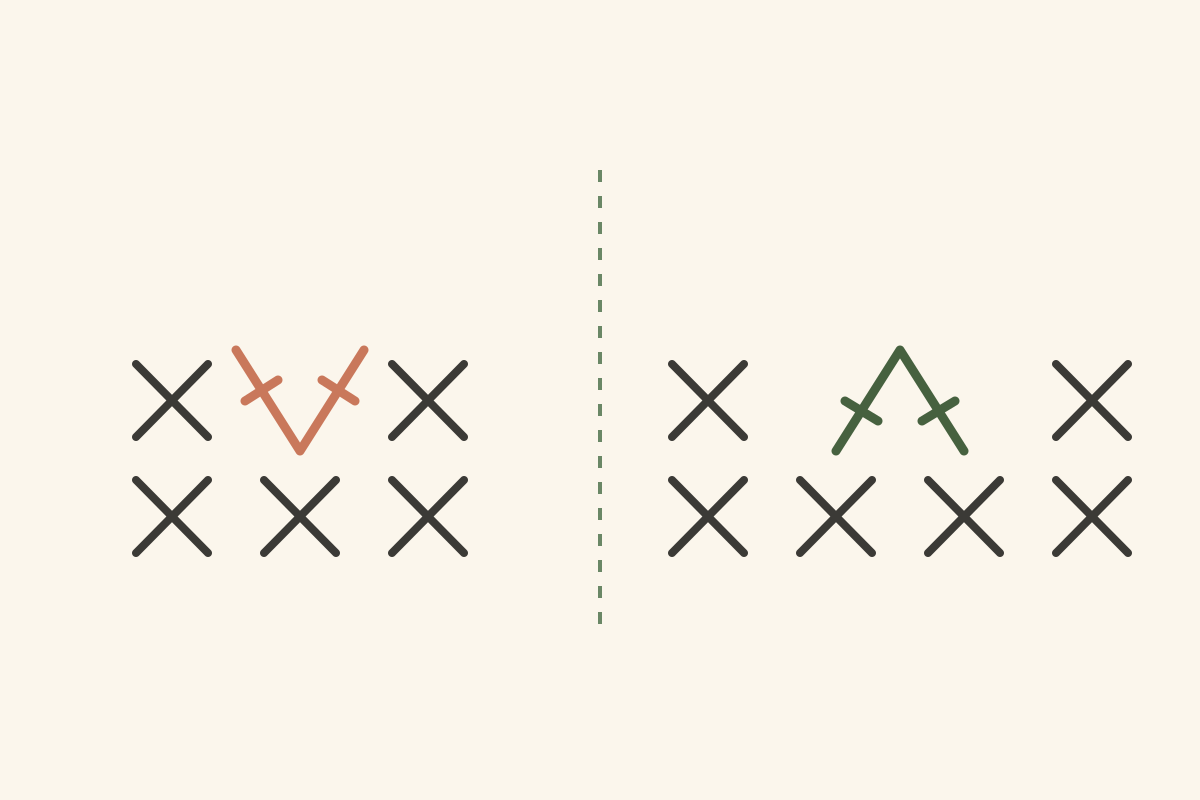
Chart key
- single crochet (sc) — UK: double crochet (dc)
- increase (2 stitches in one stitch) (inc)
- single crochet two together (sc2tog) — UK: double crochet two together (dc2tog)
The invisible decrease is the go-to way to reduce stitches in amigurumi and any single crochet fabric worked in the round. It does the same job as a standard single crochet two together (sc2tog) but is much less visible, because it grabs only the front loops and leaves the back loops lying flat on the inside (wrong side) of the work. If your amigurumi heads have little holes or lumps where you decreased, this method is worth trying.
US/UK note: This page uses US terms. US single crochet (sc) is UK double crochet (dc); sc2tog is UK dc2tog.
Why the standard sc2tog shows
A regular sc2tog pulls up a loop through both loops of two stitches, leaving three loops on the hook. It works, but it leaves a slightly bulky stitch with a visible gap beside it. On a smooth, tight surface like a toy, those gaps stand out, especially once the piece is stuffed and the fabric stretches.
Step-by-step: the invisible decrease
- Insert the hook into the front loop of the next stitch, from front to back. Don’t yarn over.
- Insert the hook into the front loop of the following stitch too. You now have three loops on the hook: your working loop and two front loops.
- Yarn over and pull through both front loops. Two loops remain on the hook.
- Yarn over and pull through both loops on the hook.
- Count it as one stitch. Two stitches of the previous round became one.
Tip: The “front loop” is the loop closest to you as you work. Because only those two thin strands are gathered, the decrease sits flush with its neighbors instead of forming the bulky, gappy stitch of a standard sc2tog.
Where you’ll use it
Most amigurumi patterns write decreases as dec or sc2tog. Unless the pattern specifically asks for a standard sc2tog, you can use the invisible decrease wherever it says to decrease in single crochet. A typical closing sequence for a ball looks like this:
| Round | Instruction | Stitch count |
|---|---|---|
| A | (sc 4, dec) × 6 | 30 |
| B | (sc 3, dec) × 6 | 24 |
| C | (sc 2, dec) × 6 | 18 |
| D | (sc 1, dec) × 6 | 12 |
| E | dec × 6 | 6 |
Each round removes 6 stitches, mirroring the 6 increases per round used to grow a flat circle or the top of a sphere.
Working the round after a decrease
The decrease sits across two stitches of the old round but forms only one new stitch. In the next round, work into it as one stitch: insert under both of its top loops as usual. Keep your stitch marker in the first stitch of each round and count at the end.
Common mistakes
- Using back loops. Grabbing the back loops instead of the front loops makes the decrease more visible, not less. Front loops only.
- Inserting into the same stitch twice. Make sure the second insertion is into the next stitch.
- Pulling through all three loops at once. You would end up with a slip-stitch-like decrease that is tight and short. Pull through the two front loops first, then finish the single crochet.
- Working too loosely. Loose decreases open up when stuffed. Keep your tension even, and consider a slightly smaller hook for amigurumi.
- Stacking decreases. Like increases, decreases that sit in the same place every round make corners. Shift the decrease position from round to round.
Invisible decrease in other stitches
The same idea works for half double crochet: yarn over, insert into the front loop of the next stitch and then the front loop of the following one, pull through both, and finish the stitch. It is less common than the single crochet version; try it on a swatch to see whether you prefer it to a standard hdc2tog.
FAQ
Is the invisible decrease the same as sc2tog?
It does the same thing (turns two stitches into one), but it is worked through front loops only. Use it anywhere a single crochet decrease appears, unless the pattern specifies otherwise.
Why do I still see holes after decreasing?
Usually the hook is too large for the yarn, or the stitches are loose. Amigurumi uses a hook one or two sizes smaller than the yarn label suggests to make dense fabric.
Does the invisible decrease work when working in rows?
You can work it in rows, but the method is taught mainly for rounds. When you turn, the loops nearest you are on the other face of the fabric, so the unused back loops end up on the right side of every other row. Check the look on a swatch.
How do I close the last 6 stitches?
Cut the yarn, leaving a tail, and thread it on a yarn needle. Weave it through the front loop of each of the last 6 stitches, then pull tight to close the hole like a drawstring.
This page uses US crochet terms.