- Beginner
- 15 min
How to Crochet an Increase (inc)
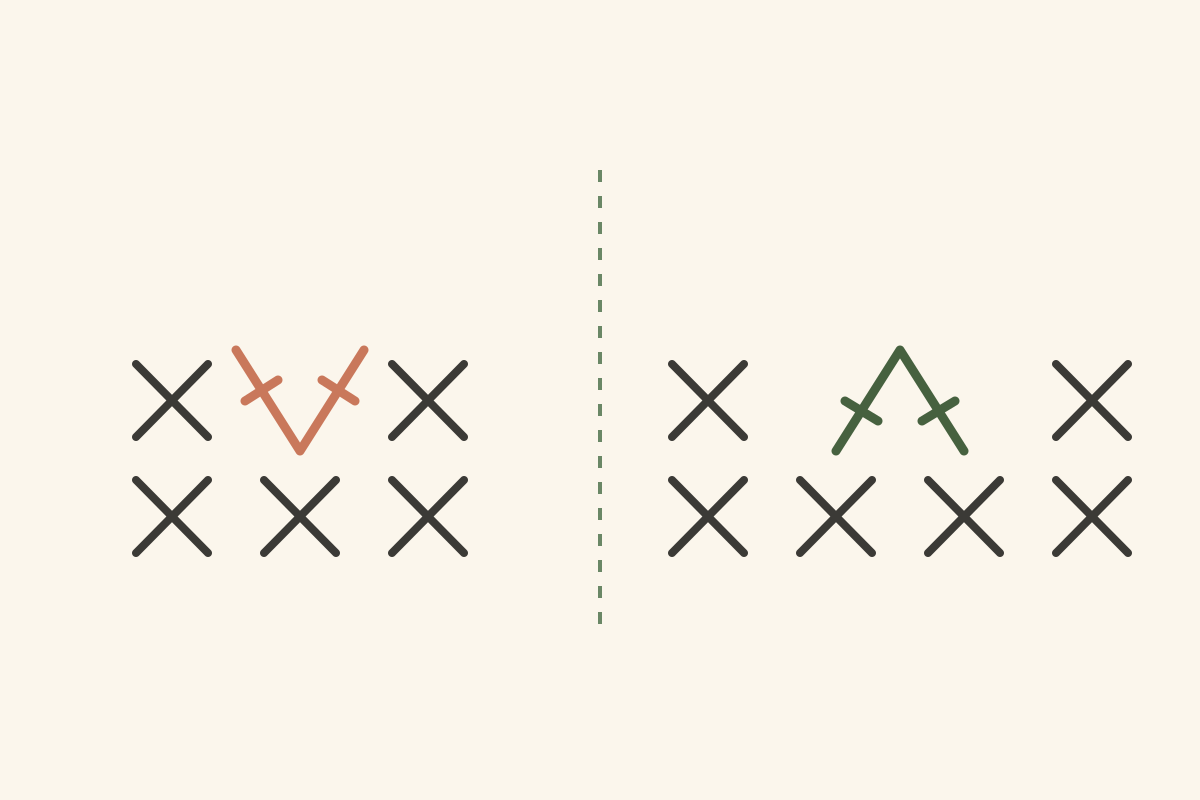
Chart key
- single crochet (sc) — UK: double crochet (dc)
- increase (2 stitches in one stitch) (inc)
- single crochet two together (sc2tog) — UK: double crochet two together (dc2tog)
An increase is the simplest shaping move in crochet: you work two stitches into one stitch, so the row or round gets one stitch wider. Increases turn a flat strip into a triangle, a magic ring into a coaster, and a coaster into the top half of a ball. Once you understand where and how often to place them, you can shape almost anything.
US/UK note: This page uses US terms. US single crochet (sc) is UK double crochet (dc); US double crochet (dc) is UK treble (tr).
What “inc” means in a pattern
In most US patterns inc means “2 sc in the next stitch.” Some patterns write it out in full: “2 sc in next st.” If a pattern is in half double or double crochet, an increase is 2 hdc or 2 dc in one stitch. Always check the abbreviation list.
Step-by-step: a single crochet increase
- Work one single crochet into the next stitch as usual.
- Insert your hook into the same stitch again, the one you just worked.
- Yarn over and pull up a loop (two loops on hook).
- Yarn over and pull through both loops.
- Count: you have made two stitches from one. That’s one increase.
Tip: After an increase, the next stitch to work is the one after the doubled stitch. Beginners often accidentally work into the same stitch a third time, or skip a stitch.
Increasing in the round: the flat-circle math
A flat circle in single crochet grows by 6 stitches every round. Why 6? Each round adds roughly one stitch height to the radius, and the circumference grows by 2π × (one stitch height). Because a single crochet is a bit shorter than it is wide, about 6 extra stitches per round matches that growth.
| Round | Instruction | Stitch count |
|---|---|---|
| 1 | 6 sc in magic ring | 6 |
| 2 | inc in each st around | 12 |
| 3 | (sc 1, inc) × 6 | 18 |
| 4 | (sc 2, inc) × 6 | 24 |
| 5 | (sc 3, inc) × 6 | 30 |
| 6 | (sc 4, inc) × 6 | 36 |
| n | (sc n−2, inc) × 6 | 6n |
The pattern is easy to remember: in round n, there are n − 2 plain stitches between increases, and the round ends with 6n stitches.
For taller stitches the number changes: half double crochet circles usually start with 8 and add 8 per round; double crochet circles usually start with 12 and add 12.
Stagger your increases
If you always place the increase at the end of each repeat, the increases stack on top of each other in six straight lines. The circle then turns into a hexagon with six visible corners. To keep it round, shift where the increase falls each round. One easy method:
- Odd rounds: (sc k, inc) × 6
- Even rounds: split the plain stitches, e.g. (sc k/2, inc, sc k/2) × 6
For example, round 4 can be worked as (sc 1, inc, sc 1) × 6 instead of (sc 2, inc) × 6. Same 24 stitches, different position. Many patterns already do this for you.
Increasing in rows
To widen a flat piece worked in rows, add one increase at the start and/or end of a row:
- At the start: after the turning chain, work 2 sc into the first stitch.
- At the end: work 2 sc into the last stitch.
Increasing at both ends adds 2 stitches per row, which makes a symmetrical triangle or trapezoid.
Invisible (less bulky) increases
Standard increases can leave a small gap, noticeable in amigurumi. A popular tidier version works the first sc of the increase into the front loop only and the second sc into both loops of the same stitch. Try both on a swatch; the effect is subtle but helps on smooth surfaces.
Common mistakes
- Losing count. Use a stitch marker at the start of each round and count at the end. Most shape problems begin with one missing or extra increase.
- Too many increases. The piece tends to ruffle or wave. Rip back to the last round with the correct count.
- Too few increases. The piece tends to cup and curl up like a bowl.
- Hexagon shape. You stacked your increases. Stagger them.
- Confusing “inc” with “sc in next 2 sts.” An increase goes into one stitch; never skip ahead.
FAQ
How do I know where to put increases?
Spread them evenly. Divide the number of stitches you will work into by the number of increases you need. Example: 30 stitches and 6 increases gives one increase every 5 stitches, so (sc 4, inc) × 6.
Does an increase count as one stitch or two?
Two. When a pattern gives a stitch count at the end of a round, each increase contributes two stitches.
Why is my circle wavy?
Usually too many increases, or a hook that is too large for your tension. Check your counts against the table above, then try a smaller hook.
What is the opposite of an increase?
A decrease (sc2tog), where you work two stitches together into one. In amigurumi many crocheters use the invisible decrease because it is less visible.
This page uses US crochet terms.