Crochet Hook Size Chart (mm, US and UK)
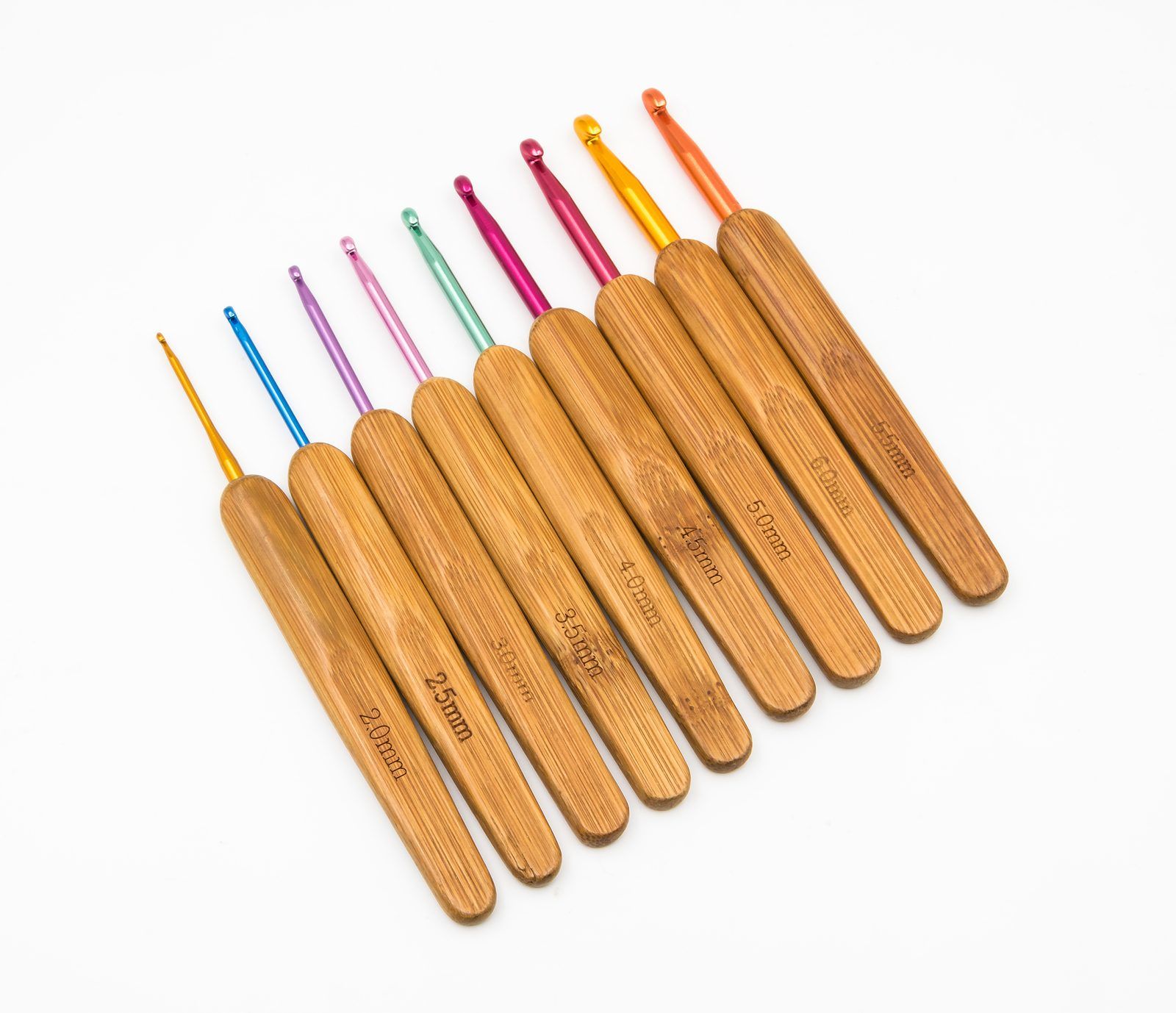

The chart above converts between the hook sizing systems you’ll meet in patterns: metric millimeters, US letter-and-number sizes, old UK numbers and Japanese 号 sizes. Use it when a pattern lists a size you don’t recognize, when you inherit unmarked hooks, or when you’re choosing a hook for a new yarn.
How to use the chart
- Find the size your pattern or yarn label gives, in whichever system it uses.
- Read across to the millimeter size. That’s the number that actually matters, because it’s the diameter of the hook’s shaft, which sets the size of your stitches.
- Choose a hook marked with that millimeter size. Most modern hooks print the mm size on the handle or thumb rest, often alongside a US letter.
Tip: Patterns usually say “or size needed to obtain gauge.” The listed hook is a starting point, not a rule. If your stitches are too big or too small, change hooks until your gauge matches.
Why millimeters are the reliable measure
Millimeters measure the shaft directly, so 5 mm is 5 mm whatever the brand. Letter and number sizes are labels, and they haven’t always been standardized:
- US letters vary between brands. Most current hooks agree on the common sizes (for example, G-6 = 4 mm and H-8 = 5 mm), but some brands have historically labeled a G as 4.25 mm, and some brands attach letters to in-between sizes too (for example, a 5.25 mm I or a 5.75 mm J).
- Some sizes have no letter, such as 4.5 mm, which is usually labeled simply “7”.
- Old UK sizes run backwards: the higher the number, the smaller the hook. An old UK 14 is 2 mm, an old UK 8 is 4 mm and an old UK 4 is 6 mm. Modern UK patterns and hooks use millimeters; the old numbers appear mainly in vintage patterns.
- Old UK sizes above 6 mm are left blank. Some charts continue the series past UK 4 (6 mm) with numbers such as 3, 2, 0, 00 and 000, but we could not find a reliable published source for those conversions, so the chart shows a dash instead. If a vintage pattern uses one of them, choose a hook by gauge.
When a vintage pattern gives only a letter or an old number, use the chart to find the nearest mm size, then make a gauge swatch.
Hook size by yarn weight
As a quick orientation, these are the typical hook ranges for each standard yarn weight:
| Yarn weight | Common names | Typical hook range |
|---|---|---|
| 0 Lace | lace, thread | steel 1.4–1.6 mm, or a regular 2.25 mm (B-1) |
| 1 Super fine | fingering, sock | 2.25–3.5 mm |
| 2 Fine | sport | 3.5–4.5 mm |
| 3 Light | DK, light worsted | 4.5–5.5 mm |
| 4 Medium | worsted, aran | 5.5–6.5 mm |
| 5 Bulky | chunky | 6.5–9 mm |
| 6 Super bulky | super chunky | 9–15 mm |
| 7 Jumbo | jumbo, roving | 15 mm and up |
These ranges follow the general guidance used across the US yarn industry, but your yarn label is a better guide than any general table. Many worsted labels, for example, recommend 5 mm (H-8), slightly below the range above. Labels reflect how the yarn behaves; ranges are averages.
Choosing a different size on purpose
- Amigurumi: go 1–2 sizes smaller than the label suggests so the fabric is dense and stuffing won’t show.
- Drapey shawls and lace: go 1–2 sizes larger for an open, flowing fabric.
- Tight crocheters: if your fabric is stiff and your gauge has too many stitches, a larger hook relaxes it.
- Loose crocheters: if your fabric is floppy, a smaller hook firms it up.
Steel hooks are different
Steel hooks for thread crochet have their own numbering, and it also runs backwards: the larger the steel hook number, the smaller the hook. Brands differ more here than with regular hooks, so always check the mm size printed on the hook.
Measuring an unmarked hook
If your hook has no markings, use a needle and hook gauge: a flat card or plate with holes of known sizes. Slide the shaft (not the throat or the tip) through the smallest hole it fits. Measure the part of the hook that forms the loops, just below the throat, where the shaft is at its full width.
Common mistakes
- Trusting the letter alone. Check the mm size, especially across brands or with vintage hooks.
- Measuring the tip. The tip is tapered; measure the full-width shaft.
- Ignoring gauge. The same hook gives different results for different crocheters. Always swatch for fitted items.
- Mixing hooks mid-project. Two “same size” hooks from different brands can feel and work slightly differently.
FAQ
What size crochet hook is best for beginners?
A 5 mm (US H-8) or 5.5 mm (US I-9) hook with worsted weight yarn. It’s large enough to see stitches clearly but not unwieldy.
Is an H hook 5 mm?
On current US hooks, yes: H-8 is 5 mm. Some older hooks and a few brands differ slightly, so check the mm marking if precision matters.
What is the difference between US and UK hook sizes?
The US uses letters and numbers (for example H-8); the old UK system used numbers that run in the opposite direction (for example UK 6 = 5 mm). Today both the US and UK print millimeter sizes, which are directly comparable.
Why does my pattern list a hook size I don’t have?
Choose the closest mm size you do have, make a swatch, and compare to the pattern’s gauge. Adjust up or down from there.