- Beginner
- 60 min
How to Crochet for Beginners
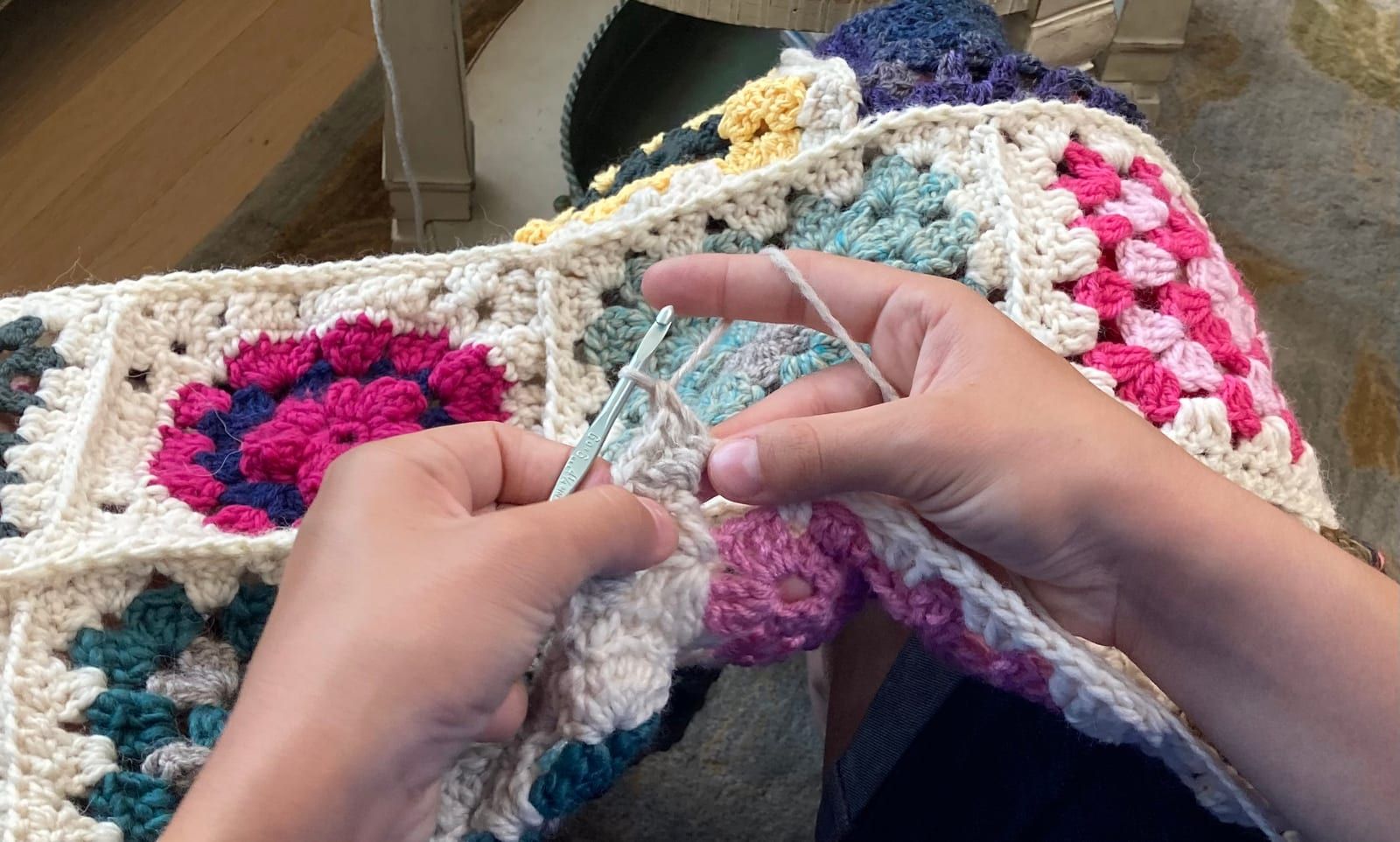

Crochet uses one hook and one strand of yarn to pull loops through other loops. That’s really all it is — every stitch, from the humble chain to an elaborate lace shawl, is built from the same few movements. This guide gives you the shortest path from “never held a hook” to a swatch of even stitches, and a plan for what to learn next.
US/UK note: this site uses US terms. US single crochet (sc) is UK double crochet; US double crochet (dc) is UK treble.
What you need to start
You don’t need much. Skip the giant kits for now.
| Item | What to choose | Why |
|---|---|---|
| Yarn | Smooth worsted-weight (#4 medium), light solid color, wool or acrylic | Easy to see stitches, doesn’t split |
| Hook | 5 mm (US H-8) — or whatever the yarn label recommends | Comfortable size for worsted yarn |
| Scissors | Any small pair | Cutting yarn |
| Yarn needle | Blunt tapestry needle | Weaving in ends |
| Stitch markers | A few locking markers, or safety pins | Marking the first stitch of a row |
Avoid dark, fuzzy, very thin or novelty yarns at first. They hide your stitches, and seeing your stitches is how you learn.
Step 1: Hold the hook and yarn
There are two common hook grips — the pencil grip (held like a pen) and the knife grip (held like a dinner knife, from above). Both are correct. Try each for a few minutes and keep whichever feels natural.
Your other hand controls the yarn. Drape the working yarn (the end attached to the ball) over your index finger and let it run through your other fingers so it feeds smoothly with gentle, steady tension. Your thumb and middle finger pinch the work just below the hook.
Tip: If your hands ache, you’re gripping too hard. Crochet is a light, relaxed movement — loosen your shoulders, too.
Step 2: Make a slip knot
The slip knot attaches the yarn to the hook.
- Make a loop in the yarn, about 6 in (15 cm) from the end.
- Reach through the loop and pull up a bit of the working yarn to form a new loop.
- Put that loop on your hook and pull the working yarn to snug it.
It should slide along the hook freely but not fall off.
Step 3: Make a chain
- Yarn over: wrap the yarn over the hook from back to front.
- Pull through the loop on your hook. That’s one chain.
- Repeat until you have 20 chains.
Count the little Vs. Don’t count the loop on your hook or the slip knot.
Step 4: Work rows of single crochet
Single crochet is the best first “real” stitch: short, sturdy and easy to count.
- Insert your hook into the 2nd chain from the hook.
- Yarn over and pull up a loop (2 loops on hook).
- Yarn over and pull through both loops.
- Work 1 sc in each chain across. You’ll have 19 sc.
- At the end of the row, chain 1 and turn the work.
- Work 1 sc in each stitch across, starting in the very first stitch.
Make 10–15 rows. Count your stitches at the end of every row — that one habit prevents most beginner problems.
Step 5: Fasten off
- Cut the yarn, leaving a 6 in (15 cm) tail.
- Yarn over and pull the tail all the way through the loop on your hook.
- Thread the tail on a yarn needle and weave it back and forth through the stitches on the wrong side.
Congratulations — that’s a complete piece of crochet.
What to learn next
Once your single crochet looks fairly even, learn these in order. Each one adds a single new idea.
- Half double crochet (hdc): yarn over before inserting, pull through all 3 loops.
- Double crochet (dc): yarn over before inserting, pull through 2 loops twice.
- Slip stitch (sl st): for joining rounds.
- Reading a simple pattern: abbreviations, repeats and stitch counts.
- A first project: a dishcloth or a simple scarf in one stitch.
Common beginner mistakes
- Gripping too tightly. Tight hands make tight stitches that are hard to work into.
- Growing or shrinking edges. Usually a missed first stitch, or an extra stitch worked into the turning chain. Count each row.
- Working only into one loop by accident. Unless told otherwise, insert under both top loops of a stitch.
- Choosing hard-to-see yarn. Dark or fluffy yarn makes everything harder.
- Expecting perfection right away. The first rows are always uneven. Your tension evens out with practice, not with effort.
FAQ
Is crochet hard to learn?
The basic movements can be learned in an afternoon. Even tension takes a few hours of practice. Most people make a usable first project within their first week or two.
Should I learn knitting or crochet first?
Either is fine. Crochet has only one active loop at a time, which many beginners find easier to fix when they make a mistake.
What size crochet hook should a beginner use?
A 5 mm (H-8) hook with worsted-weight yarn is a comfortable, common starting point. Follow the yarn label if it says otherwise.
How long does it take to learn to crochet?
You can learn chain and single crochet in an hour or two. Give yourself a few practice sessions before you judge your stitches.
Can left-handed people crochet?
Yes. Left-handers hold the hook in the left hand and work from left to right; all the stitch steps are the same, just mirrored.
This page uses US crochet terms.