- Easy
- about 60 min
Crochet Christmas Ball Ornament (Easy Bauble Pattern)
A free crochet Christmas ball ornament: a stuffed single crochet bauble with a striped band and a little cap, worked in one piece. Counts for every round.
- Skill
- Easy
- Finished size
- Approximately 2 in (5 cm) across, plus about 0.4 in (1 cm) of cap, in worsted yarn with a 3.5 mm hook. Size depends on yarn, hook and how firmly you stuff; these are estimates, not measurements.
- Gauge
- Not critical, but the fabric must be dense: if you can see stuffing between the stitches, go down a hook size.
Materials
- Worsted weight (medium, #4) yarn in three colors — Main color A (red), about 11 yd (10 m); band B (white), about 3 yd (2.5 m); cap C (gold or gray), about 1 yd (1 m). Estimated, not measured.
- Crochet hook — 3.5 mm (US E-4), smaller than the label suggests, so the stuffing doesn't show.
- Fiberfill stuffing — A small handful.
- Stitch marker, yarn needle and scissors
- Ribbon or yarn for hanging — About 10 in (25 cm).
Stitches used: magic ring (MR) · single crochet (sc) · increase (2 stitches in one stitch) (inc) · single crochet two together (sc2tog)
This bauble is a small crocheted sphere with a festive band and a little cap, so it looks like a glass Christmas ball but won’t break. It is worked in one piece in a continuous spiral, and you stuff it before you close it. If you have made a ball from our sphere tutorial, this is the same idea scaled down to 30 stitches.
US/UK note: This pattern uses US terms. US single crochet (sc) is UK double crochet (dc), and sc2tog is UK dc2tog.
Abbreviations
MR = magic ring · sc = single crochet (UK double crochet) · inc = 2 sc in the same stitch · dec = invisible decrease (sc2tog through the front loops) · st(s) = stitch(es) · rep = repeat
Pattern notes
- Work in a continuous spiral: don’t join rounds, and move a stitch marker to the first stitch of each round.
- Color changes: work the last stitch of the old color until two loops remain on the hook, then pull the new color through. Carry the unused color inside the ball, or cut it, leaving a tail to weave in.
- Increases and decreases are staggered so the ball comes out round instead of faceted.
Pattern
With A:
Round 1: Make a MR, 6 sc in ring. (6 sts)
Round 2: Inc in each st around. (12 sts)
Round 3: *Sc in next st, inc in next st; rep from * 5 more times. (18 sts)
Round 4: *Sc in next st, inc in next st, sc in next st; rep from * 5 more times. (24 sts)
Round 5: *Sc in next 3 sts, inc in next st; rep from * 5 more times. (30 sts)
Rounds 6–7: Sc in each st around. (30 sts)
Change to B in the last st of Round 7.
Rounds 8–9: Sc in each st around. (30 sts)
Change to A in the last st of Round 9.
Rounds 10–11: Sc in each st around. (30 sts)
Round 12: *Sc in next 3 sts, dec; rep from * 5 more times. (24 sts)
Round 13: *Sc in next st, dec, sc in next st; rep from * 5 more times. (18 sts)
Stuff the ball firmly, pushing the fiberfill into the outer edges first.
Round 14: *Sc in next st, dec; rep from * 5 more times. (12 sts)
Add a little more stuffing.
Round 15: (Dec) 6 times. (6 sts)
Change to C in the last st of Round 15.
Rounds 16–17: Sc in each st around. (6 sts)
Fasten off, leaving an 8 in (20 cm) tail.
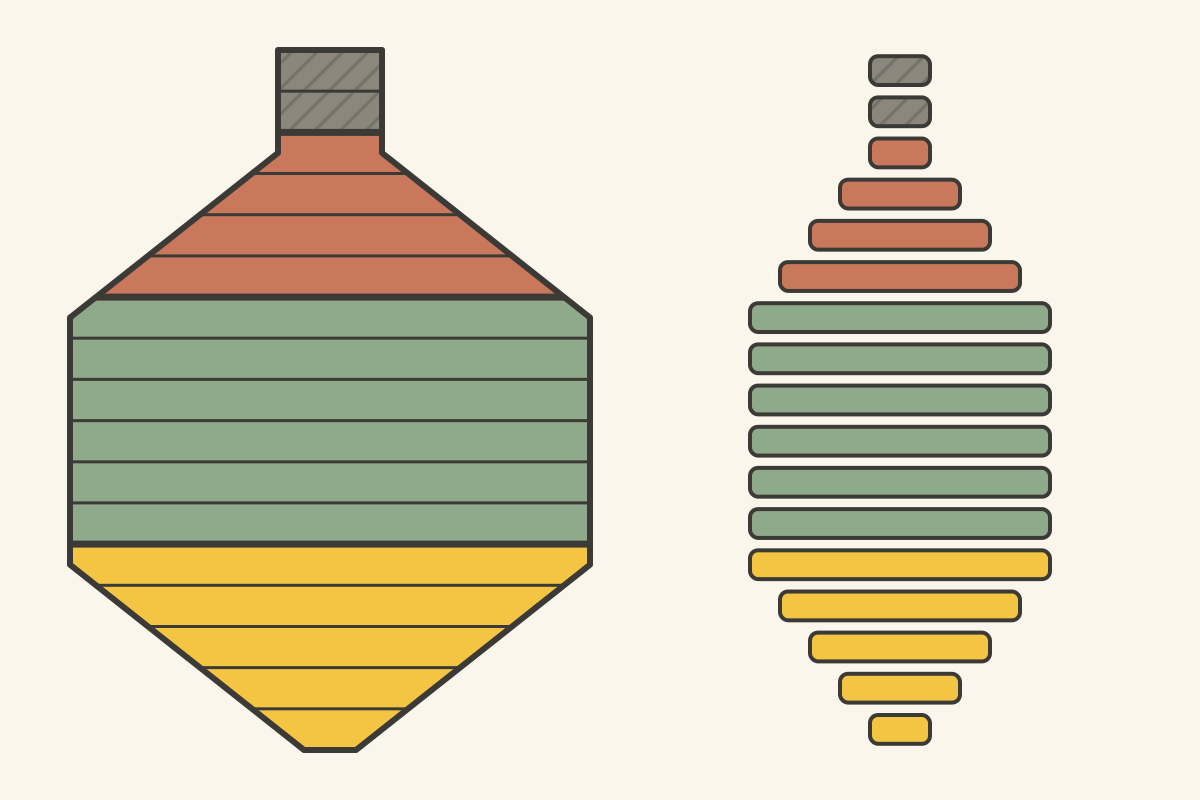
Counts at a glance
| Round | Instruction | Stitch count |
|---|---|---|
| 1 | 6 sc in MR | 6 |
| 2 | inc × 6 | 12 |
| 3 | (sc 1, inc) × 6 | 18 |
| 4 | (sc 1, inc, sc 1) × 6 | 24 |
| 5 | (sc 3, inc) × 6 | 30 |
| 6–11 | sc in each st (B on 8–9) | 30 |
| 12 | (sc 3, dec) × 6 | 24 |
| 13 | (sc 1, dec, sc 1) × 6 | 18 |
| 14 | (sc 1, dec) × 6 | 12 |
| 15 | dec × 6 | 6 |
| 16–17 | sc in each st (C) | 6 |
Closing and finishing
- Thread the C tail on a yarn needle and weave it through the front loop of each of the 6 stitches of Round 17.
- Pull tight to close the top of the cap like a drawstring.
- Push the needle down through the cap and out through the ball, then back up, so the tail is anchored. Don’t trim it yet if you want to use it for the hanging loop.
- Weave in the color-change tails inside the ball.
Hanging loop
Thread 10 in (25 cm) of ribbon or yarn on a yarn needle, pass it under a stitch at the top of the cap and tie the ends together. Or use the C tail: ch 12 with it, sl st back into the top of the cap, then weave in the end.
Stitch chart
Common mistakes
- Stuffing shows through: the hook is too big for your tension. Go down a size (3 mm) and keep the stitches tight.
- Faceted or hexagonal ball: the increases or decreases are stacked. Follow the staggered repeats exactly.
- Lumpy shape: stuffed too little or unevenly. Add small tufts and roll the ball between your palms.
- A step in the stripes: a spiral always has a small jog where the rounds meet. Hang the ornament with that side at the back.
- Wrong side out: the right side shows neat Vs. If you see horizontal bars, push the piece inside out before stuffing.
Variations
- Size: for a bigger bauble, add one more increase round (*sc in next 2 sts, inc in next st, sc in next 2 sts; rep from * 5 more times, 36 sts) and one more even round, then mirror the decreases as in the sphere tutorial.
- Color: make it in one color with a metallic yarn cap, or stripe every two rounds for a candy look.
- Firmness: the stuffing holds the shape, so this bauble needs no stiffener. For a lighter ornament, stuff it softly; it will squash a little more.
FAQ
Can I crochet over a plastic ball instead of stuffing it?
You can put a plastic ball of about the same size inside before Round 13. Size depends on your tension, so make the ball first and measure it before you buy one.
Why are there 6 even rounds?
A sphere needs about as many rounds as half its circumference in stitches. With 30 stitches, 5 increase rounds, 6 even rounds and 4 decrease rounds give a round ball. If yours looks like an egg, remove an even round; if it looks squat, add one.
Can I join each round instead of spiraling?
Yes (sl st to the first sc, ch 1), but joins leave a visible seam on a smooth ball. Spiraling is usual for amigurumi.
This page uses US crochet terms.